

The Australian Society of Anaesthetists has made a submission to the House Standing Committee on Health, Aged Care and Disability’s Inquiry into access to and affordability of medical specialists in Australia.
The submission argues that improving access and affordability requires more than a narrow focus on just specialist fees. Patients’ out-of-pocket costs are shaped by the interaction between workforce and service capacity, referral pathways, Medicare benefits, private health insurer benefits, specialist fees and the information available to patients before treatment.
Expanding effective specialist capacity
Anaesthetists play an essential role in enabling surgery and supporting emergency, maternity and other complex care across public and private settings.
The ASA’s workforce modelling forecasts that demand for anaesthesia services will increase by 35.7 per cent between 2017 and 2032, compared with projected workforce growth of 31.8 per cent. Under the base scenario, demand is projected to exceed supply by 343 anaesthetists in 2032. If average workload falls by 2.5 per cent, the projected shortfall increases to 507 anaesthetists.
The submission recommends a nationally coordinated specialist workforce strategy, including funding at least 50 additional anaesthesia trainees each year, with one-third undertaking training in regional and rural Australia. It also calls for sustainable regional training networks, sufficient supervision and flexible employment arrangements that help retain specialist capacity across public and private services.
Addressing the full cost of specialist care
The ASA emphasises that a specialist’s fee and a patient’s out-of-pocket cost are related, but they are not the same. For insured in-hospital care, the patient’s gap reflects the difference between the specialist’s fee and the combined benefits paid by Medicare and the patient’s private health insurer.
The submission highlights the long-term decline in the relative value of MBS anaesthesia benefits. Between 2001 and the end of 2025, the MBS anaesthesia Relative Value Guide unit value increased by 34.7 per cent, compared with a 91.6 per cent increase in headline CPI. Over the corresponding period, the ABS Health group increased by 189.7 per cent and the Medical and hospital services subgroup increased by 282.3 per cent. The submission notes that these consumer price measures provide economic context and do not, by themselves, determine an appropriate fee or Medicare benefit.
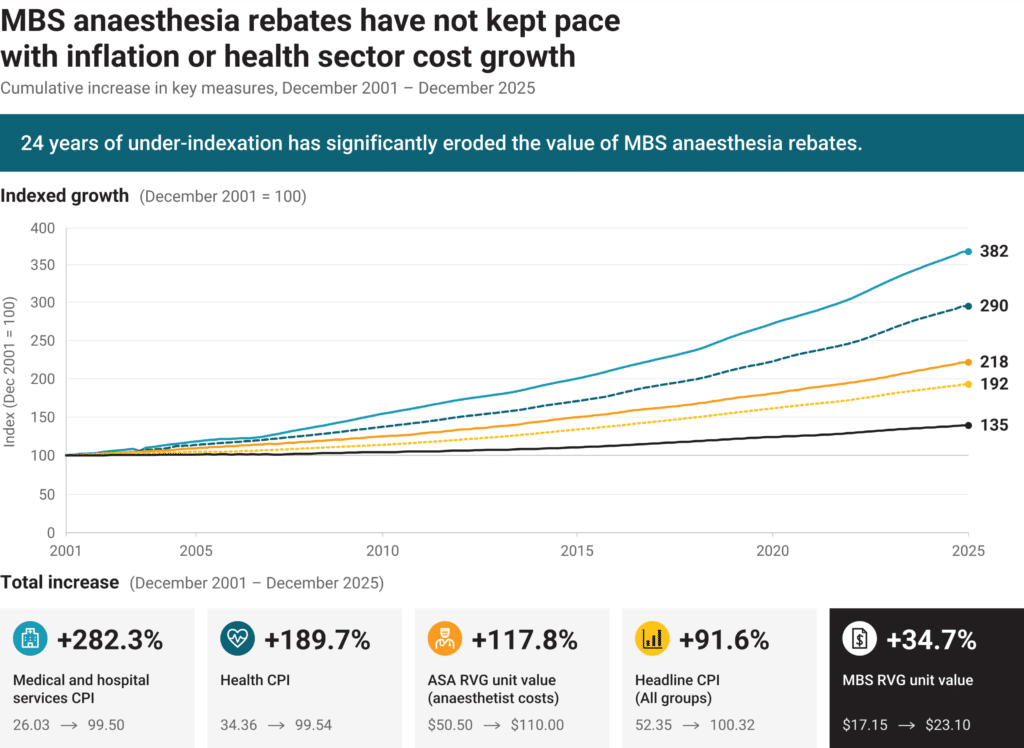
The ASA has called for an independent review of MBS anaesthesia benefits, private health insurer benefit schedules, known-gap limits and other scheme rules that affect patients’ final costs and practitioners’ participation in insurer arrangements.
A coordinated reform program
The submission makes six principal recommendations:
- develop and fund a nationally coordinated specialist workforce strategy;
- establish nationally consistent requirements for referral transparency and continuity of care;
- commission an independent review of Medicare and private health insurer benefit settings;
- require integrated financial transparency before planned care;
- establish a specialty-specific, staged and proportionate framework for addressing excessive charging; and
- align investment in service capacity and emerging models of care with improved national data and evaluation.
The ASA supports ethical, reasonable and transparent fee setting and does not support excessive or egregious charging. However, any response should distinguish genuinely unreasonable conduct from legitimate variation arising from clinical complexity, service duration, billing structures and insurer arrangements. For anaesthesia, assessment should be based on complete episode-level information and specialty-specific analysis.
The central test of reform should be whether patients can move safely and promptly from referral to treatment at a cost they can afford. Achieving this will require shared responsibility across governments, health services, private health insurers, hospitals and the medical profession.
Read the ASA’s full submission.
This submission builds on the ASA’s submissions from March and August. You can read all ASA submissions on the ASA website at https://asa.org.au/representation/asa-submissions.
ASA advocacy
Speaking in the Australian Financial Review yesterday, ASA President Dr Vida Viliunas highlighted the need for a broader approach to healthcare affordability, arguing that scrutiny should extend beyond specialist fees to Medicare rebates and private health insurer no-gap and known-gap arrangements.
“When rebates and insurer benefits fail to keep pace with the cost of delivering care, patients shoulder more of the expense. Publishing a fee makes it visible. It does not make an inadequate rebate sufficient,” said Vida Viliunas, president of the Australian Society of Anaesthetists.
“Government should examine Medicare indexation and insurers’ no-gap and known-gap arrangements with the same seriousness it applies to specialist charging. Transparency and accountability must extend to everyone whose decisions determine what patients pay.”
Also this week, ASA CEO Dr Matthew Fisher met with parliamentarians in Canberra to reinforce that specialist access and affordability are system-wide issues requiring coordinated action – not finger pointing or blame directed at anaesthetists or other medical specialists.